
Trimming & pruning
Winter tree care in Boise: getting your trees ready
Short answer
Winter tree care in Boise is mostly fall work: deep-water young trees and evergreens before the ground freezes, remove dead and broken limbs, shorten heavy branches over the roof, and wrap thin-barked young trunks. Save major pruning for late winter.
Why winter tree care in Boise starts in fall
The best winter tree care in Boise happens before winter arrives. The National Weather Service office in Boise notes that most lower-elevation sites in the area reach their first frost or freeze in October, and by then the easy jobs get harder: hoses are put away, soil starts to firm up, and an early wet snow can land on trees that still have their leaves. Preparing trees for winter is mostly a short checklist you can work through in a couple of fall weekends.
Give trees a deep drink before the ground freezes
Boise summers are dry and falls often are too, and a tree that goes into winter short on water is more likely to show dieback in spring. Evergreens are the most exposed because they keep losing moisture through their needles all winter. University of Idaho Extension advises a deep watering in late fall if the season has been dry.
- Water slowly at the drip line, not against the trunk. A hose on a slow trickle for a few hours works well.
- Aim to wet the soil about a foot deep, then move the hose so the whole root area gets water.
- Pick a mild day when the soil isn’t frozen, and drain hoses and shut off outdoor taps afterwards.
- Young trees planted in the last few years need this the most.
Skip the fall fertilizer. Extension guidance for Idaho is to fertilize trees in spring only, because feeding late in the season can push growth that isn’t ready for cold weather.
Fall tree pruning: what to cut now and what to leave
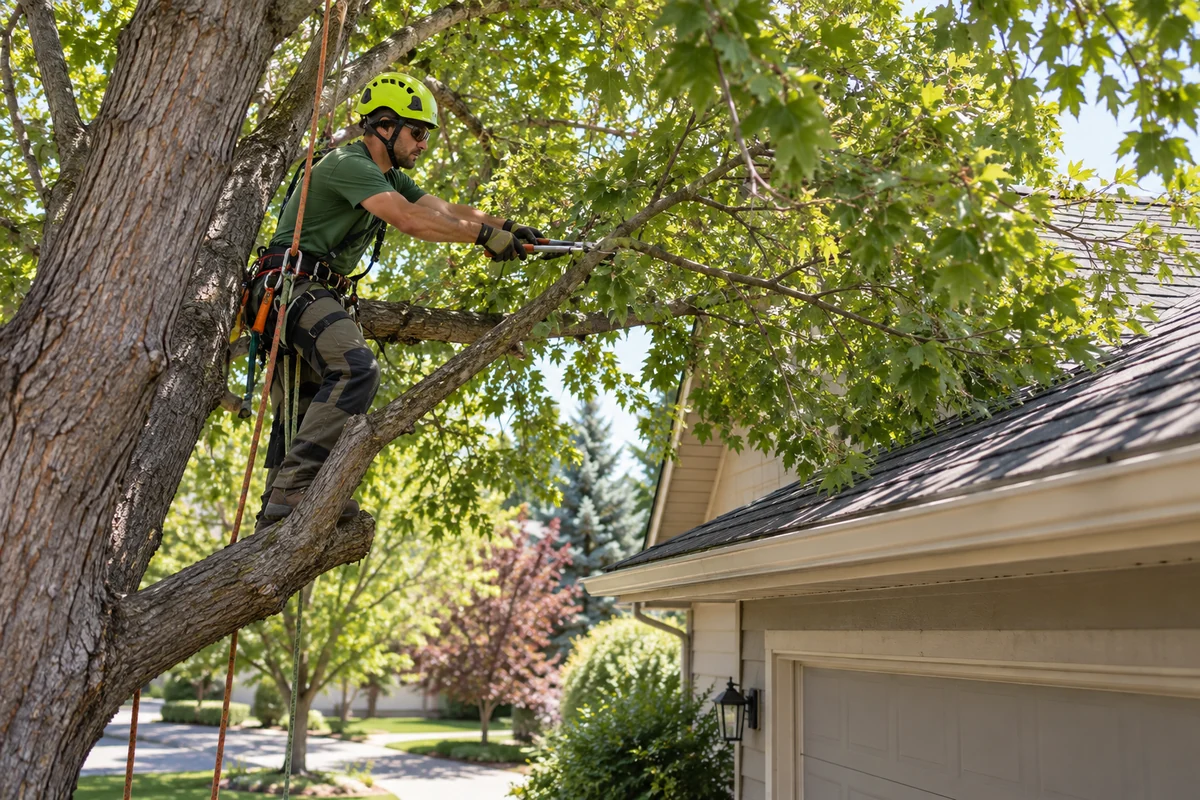
Fall is a good time to take out what’s already dead or broken. Dead branches are brittle and are often the first to come down under snow or wind, and they’re easy to spot before the leaves drop because they have none. Limbs rubbing the roof, gutters or siding are worth shortening now as well.
Heavier structural work is a different job. On most shade trees, major tree pruning to fix weak forks or thin a crowded canopy is better done once the tree is dormant, and our season-by-season trimming guide explains why late winter usually wins. If you’re not sure which branches matter, a fall walk-around is a sensible time to ask.
One local rule: in Boise, any pruning or removal of an elm, on public or private property, needs a free permit from the City Forester first. Trees in the strip between the sidewalk and street are public trees, and work on those needs a City permit too.
Branches over the roof, driveway and walks
Snow and ice add a lot of weight to a branch, and long horizontal limbs over a roof, car or front walk are the ones to look at first. Shortening an overextended limb, rather than removing it, often takes enough weight off the end to reduce the risk. Routine tree trimming to clear roofs, driveways and sidewalks is a straightforward fall job and doesn’t harm a healthy tree.
If a tree already has a split trunk, a crack where two stems meet, or a lean that’s new, don’t wait for the first storm to find out. Our guide to storm-damaged trees covers what can wait and what can’t once a limb does fail.
Trees near power lines
Idaho Power notes that heavy snow or strong wind can bring trees down onto power lines and cause outages. Don’t trim near those lines yourself. Idaho Power asks people to stay at least 10 feet away from overhead lines and to call 208-388-2323 if a tree is growing into them; the utility clears its lines using qualified line-clearance contractors. The wire running from the pole to your house is handled differently, and the details are in our guide to trees near houses and power lines.
Protect young, thin-barked trees from sunscald
Bright winter sun can warm the south and southwest side of a trunk during the day, and the sharp drop after sunset can crack the bark. University of Idaho Extension calls this sunscald, or southwest injury. Young trees with thin bark are the most at risk. A light-colored paper tree wrap put on in fall, or a coat of white water-based latex paint diluted with water, reflects the sun and reduces the risk. Don’t leave a wrap on for good; take it off when the risk has passed and check the bark underneath for insects.
Mulch and fall cleanup
A ring of wood-chip mulch helps hold soil moisture and evens out soil temperature over winter. Keep it a few inches away from the trunk so bark stays dry. Rake up leaves from trees that had leaf spot or other foliage diseases this year rather than leaving them under the tree, and look over the base of each trunk for cracks, fungus or loose soil while you’re there.
A quick fall checklist
- Deep-water young trees and evergreens before the ground freezes.
- Remove dead and broken branches; leave big structural cuts for late winter.
- Shorten heavy limbs over the roof, driveway and walks.
- Check elms and street trees for permit needs before any cutting.
- Call Idaho Power about any branch growing into a line.
- Wrap or paint thin-barked young trunks, and don’t leave wraps on year-round.
- Top up mulch, keeping it off the trunk.
FAQ
Common questions
When should I start preparing trees for winter in Boise?
In early to mid fall. Boise and most lower Treasure Valley sites usually see their first frost or freeze in October, so watering, deadwood removal and roof clearance are easiest to get done before then.
Should I water trees in the fall in Boise?
Yes, if the fall has been dry. Give trees a slow, deep soak before the ground freezes, especially young trees and evergreens, then shut off and drain the hose.
Is fall a good time for tree pruning?
Fall tree pruning is fine for deadwood, broken limbs and branches over the roof. Bigger structural pruning on most shade trees is better left until the leaves are down, ideally late winter.
Can I trim a branch touching a power line before winter?
No. Stay at least 10 feet from overhead lines and call Idaho Power at 208-388-2323. Only qualified line-clearance crews should work near energized lines.