Storm and emergency guide
What to do when a storm damages a tree in Boise
After a windstorm or heavy snow, the first job is keeping people safe, not cleaning up. Stay clear of downed lines and hanging limbs, work out whether the tree is yours or the city's, and then decide whether it needs emergency removal now or a planned visit once things settle.
Updated October 2, 2026
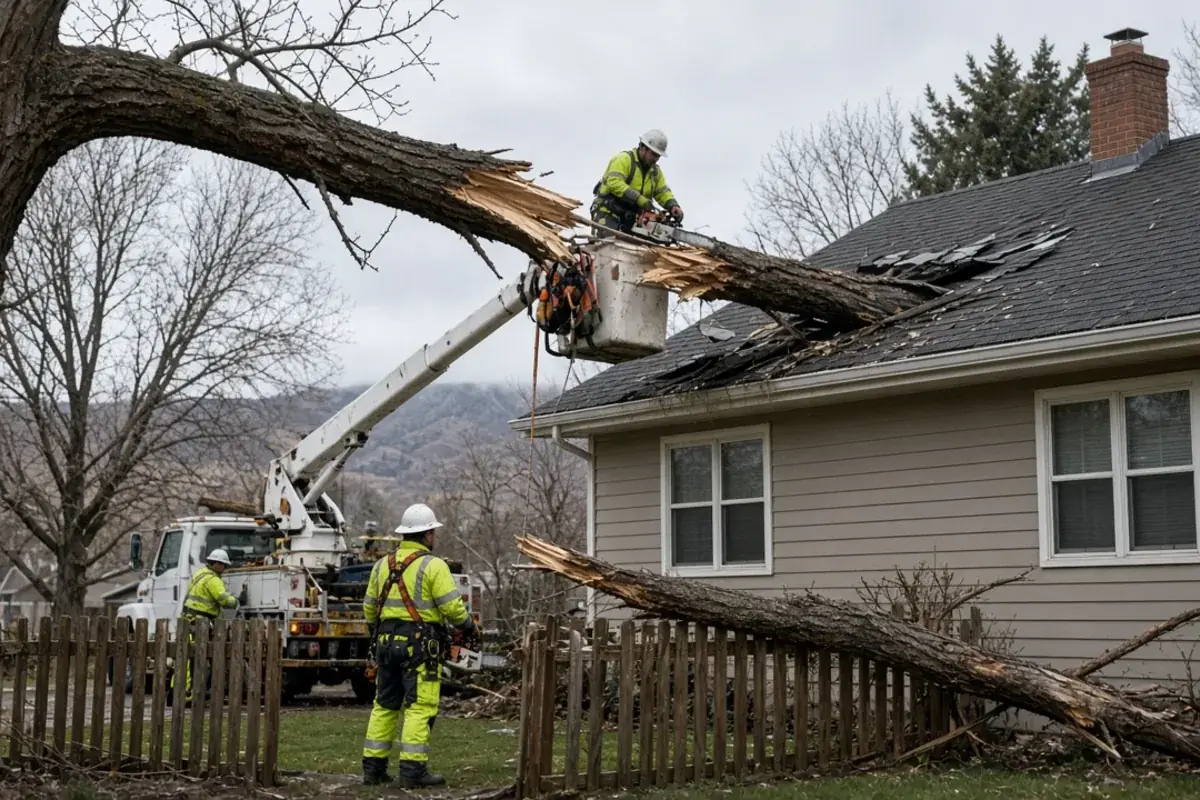
Safety comes before cleanup
Boise gets its share of strong wind events, along with the occasional wet snow that loads branches heavily, especially when it arrives before the leaves have dropped or after they come back in spring. When trees fail, the most dangerous pieces are often the ones still in the air: broken limbs caught in the canopy, sometimes called hangers, and trunks resting on a roof, fence or another tree.
Keep children, pets and cars away from the area. Do not pull on broken limbs or try to cut a trunk that is bent or pinned, because wood under tension can spring back or shift without warning. If a tree or branch is touching a power line, treat the line as live, stay well back and call Idaho Power, or 911 if anyone is in danger.
Is it an emergency or can it wait?
Some damage needs attention the same day. A tree on the house, a split trunk that could finish failing, a large hanging limb over a doorway or driveway, a tree blocking the only way in or out, and a tree that is newly leaning with roots lifting all fall into that group.
Other damage looks dramatic but is not urgent: a few broken branches on the lawn, a small limb on the fence, or some canopy damage on a tree that is otherwise standing straight. Those can usually wait for a planned visit. Our emergency tree removal page explains how urgent jobs are approached, while planned work falls under standard tree removal in Boise.
Power lines and Idaho Power
Never trim or remove a tree that is touching or near a power line yourself. Idaho Power says only specially trained professionals should work near its lines and asks people to stay at least 10 feet away. Report downed lines, or trees and limbs on lines, to Idaho Power right away.
The wire running from the pole to your house, the service drop, is a special case. Idaho Power generally says routine pruning around service wires is not part of its line-clearing work, but it can de-energize the line during business hours so the work can be done safely. Our guide to removing a tree near a house or power lines explains this in more detail.
Street trees and private trees
If a tree or branch from the planting strip falls onto the street or sidewalk, the City of Boise's Community Forestry team generally handles it, and the city says it responds to tree emergencies on streets and sidewalks around the clock. When a privately owned tree drops debris on the street or sidewalk, city crews may move it out of the way, but the owner is responsible for hauling it off.
During a big storm, city crews and tree companies can be swamped, and the city prioritizes blocked streets, sidewalks, parks and the Greenbelt. For trees on your own property, you will need a private tree service, so it is worth calling early and describing exactly what is at risk.
Can the tree be saved?
Often, yes. Many trees lose some branches in a storm and recover well with careful pruning. The questions that decide it are whether the trunk is intact, whether the root plate has moved and how much healthy crown is left. A tree that has lost a major limb from a split fork, has a crack running into the main trunk, or has lifted partly out of the ground is usually a removal candidate.
Species matters as well. Silver maple, cottonwood and Siberian elm, all common in older parts of the West Bench, Hyde Park and Southeast Boise, tend to break more easily and can keep failing after the first damage. For a closer look at warning signs, see signs a tree needs to be removed, and for the keep-or-remove decision, read our guide to saving or removing a tree.
Insurance and neighbor trees
Who pays after a storm depends on your policy, where the tree landed and the condition of the tree before it fell. As a general rule, many homeowners policies treat a tree that damaged a covered structure differently from a tree that simply fell in the yard, and a neighbor's tree that falls on your property is often handled through your own policy unless the tree was clearly neglected. Policies vary a lot, so call your insurer before assuming anything.
If it is safe, take photos of the tree, the damage and the surroundings before any cleanup starts, and keep a record of who you talked to and when. A tree service can describe the work that is needed, but coverage decisions come from your insurance company.
After the hazard is handled
Once the urgent pieces are down, the rest can be planned: removing what is left of a badly damaged tree, cleanup, and dealing with the stump through stump grinding. Call 811 before any grinding so buried lines can be marked. If you are wondering what changes the scope of the follow-up work, our tree removal cost guide explains the main factors.
It is also a good time to look at the trees that made it through. Removing dead wood and thinning weak, overextended limbs before the next windy season can reduce the chance of a repeat. We help homeowners across Boise, including the West Bench and Southeast Boise, with both urgent work and follow-up. When storm damage has turned into a removal, our Boise tree removal service is the place to start.
Common questions
A few things people usually want to know
Should I cut up a fallen tree myself after a storm?+
Small branches on the ground are usually fine to clear. Avoid cutting trunks or limbs that are bent, pinned or hanging, and never work near power lines, because wood under tension can move suddenly.
Who do I call if a tree is on a power line in Boise?+
Stay well away and contact Idaho Power, or call 911 if there is immediate danger. Do not try to remove or trim anything that is touching a line.
Who cleans up a street tree that falls in Boise?+
Trees in the public right-of-way are generally handled by City of Boise Community Forestry, which responds to tree emergencies on streets and sidewalks. Private trees are the owner’s responsibility.
Does homeowners insurance pay for tree removal after a storm?+
It depends on your policy and what the tree hit. Coverage is often different for a tree that damaged a structure than for one that fell in the yard, so check directly with your insurer.
Can a storm-damaged tree be saved?+
Often, if the trunk and roots are intact and enough healthy canopy remains. Split trunks, cracks into the main stem and lifted root plates usually point toward removal.
Keep reading
More tree removal guides
Signs a tree needs to be removed
Dead canopy, cracks, a new lean, decay and the Boise trees that tend to fail first.
Removing a tree near a house or power lines
How sectional removal works and how Idaho Power lines change the plan.
What to expect on tree removal day
The steps from estimate to cleanup, how to prepare and the best time of year.
Remove or save a tree?
How to decide between trimming, pruning and removal for a problem tree.
How much does tree removal cost in Boise?
The factors that change the scope and price of a removal.
Tree removal permits in Boise
Street trees, Community Forestry, HOAs and other approvals to check first.
Stump grinding vs stump removal
Which stump option fits the space after the tree comes down.
Talk through the tree
Prefer to call? Start there.
If you can describe what the tree is doing, where it sits on the property and what you want to accomplish, that is enough to start the conversation. For urgent damage, mention whether the tree is leaning, split, blocking access or resting on a structure.