Tree removal guide
How do you know when a tree needs to be removed?
Most trees that need to come down give some warning first. Dead or dying canopy, cracks in the trunk, a lean that is new or getting worse, fungus at the base and roots lifting out of the soil are the signs worth taking seriously, especially when the tree stands over a house, driveway, fence or play area.
Updated October 2, 2026
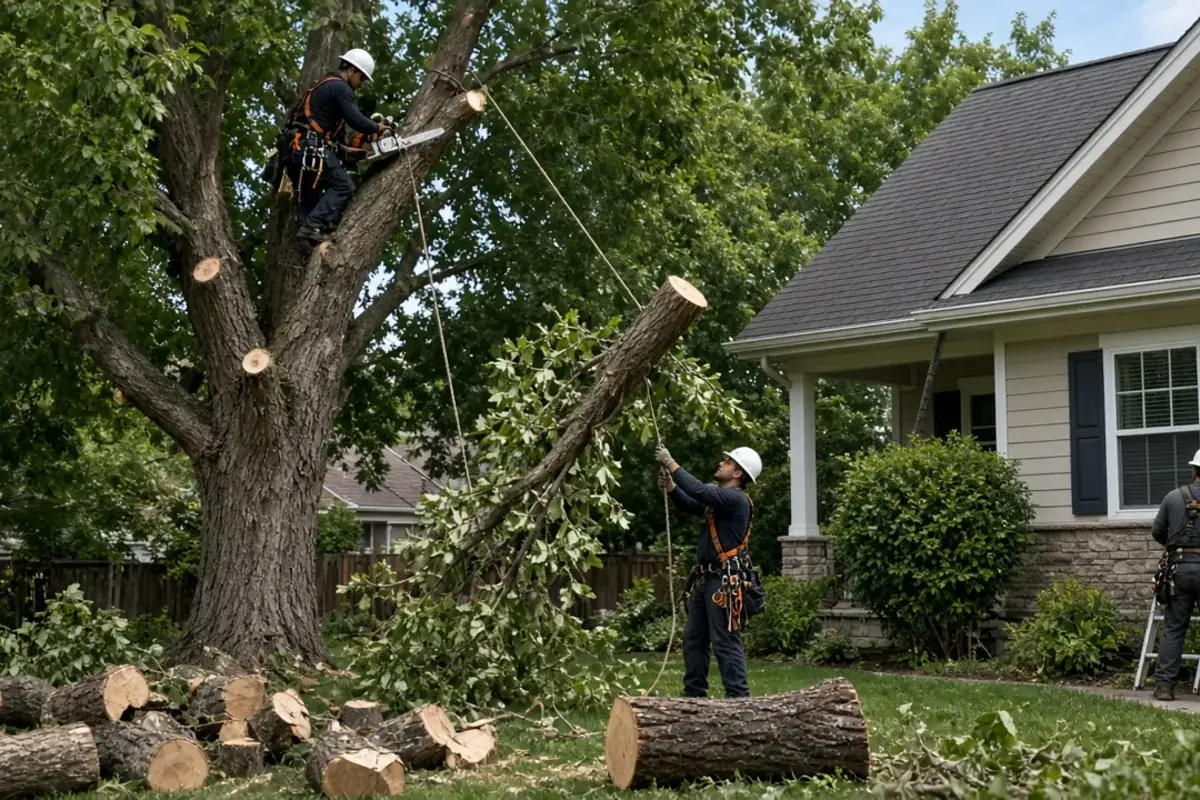
Start with what the tree could hit
A tree with a problem is not automatically a dangerous tree. Arborists usually think about risk as two things together: how likely part of the tree is to fail, and what it would land on if it did. A dead tree at the back of a large lot in Barber Valley is a different situation from the same tree leaning over a bedroom in the North End.
So as you go through the signs below, keep asking what sits under the tree. Roofs, cars, fences, sidewalks, patios, play equipment and power lines all raise the stakes. When a defect and a target line up, that is usually when tree removal in Boise moves from something to think about to something to plan.
Dead or dying canopy
The easiest sign to spot is a tree that leafs out poorly or not at all. In spring, compare it with similar trees on your street. Thin, small or yellowing leaves, branches that stay bare, and dieback that starts at the top of the crown and works down are all signs that the tree is struggling.
A few dead branches can usually be pruned out. The concern grows when large sections of the crown are dead, when dieback keeps spreading year after year, or when bark is loose and falling away in sheets. Dead wood dries out and becomes brittle, and a fully dead tree generally gets less predictable to work on the longer it stands, which is one reason not to wait too long once a tree has clearly died.
Cracks, splits and weak forks
Look at the trunk and at the points where major limbs join it. Deep vertical cracks, a seam that runs down from a fork, or a split you can see light through are serious defects. Trees with two or more trunks of similar size growing from one point, often called codominant stems, can form a tight V-shaped union with bark trapped inside it. Those unions are a common failure point in wind and heavy snow.
A crack that appears suddenly after a storm deserves prompt attention. A long-standing weak fork can sometimes be managed with pruning or cabling, but that is a judgment call that depends on how much sound wood remains and what is underneath.
A new or worsening lean
Plenty of trees grow with a lean and stay that way for decades. The lean to worry about is one that is new or getting worse. Look at the ground on the side opposite the lean: cracked or heaving soil, a raised mound, or roots pulling up out of the lawn suggest the root plate is moving.
After a strong wind or a wet, heavy snow, walk around your larger trees and look for exactly this. If the soil has shifted, keep people and cars out from under the tree and have it looked at soon. Our guide to storm-damaged tree removal in Boise covers what to do first.
Decay, fungus and root damage
Mushrooms or shelf-like conks growing on the trunk or around the base often mean decay inside the wood or roots. Other clues include cavities, soft or crumbly wood, oozing, carpenter ants and a hollow sound when the trunk is tapped. Decay is not always fatal, because trees can wall off damage, but the amount of sound wood left is what matters.
Roots get damaged too. Trenching for a sprinkler line, a new driveway, a home addition or a fence along the root zone can cut major roots, and the tree may not show the effects for a year or more. If a big tree's roots were disturbed during construction, it is worth watching it more closely for thinning and dieback.
Boise trees that tend to cause trouble
Some of the most common large trees in older Boise neighborhoods are also the ones most often involved in failures. Silver maple, Siberian elm and cottonwood grow fast and tend to have weaker wood. They are known for dropping limbs in wind and heavy snow, and many were planted decades ago in neighborhoods like the West Bench, the North End and Southeast Boise. Large willows and poplars can behave in a similar way.
Ash trees are another one to watch. Emerald ash borer, an invasive beetle that has killed huge numbers of ash trees elsewhere in the country, had not been confirmed in Idaho as of 2026, according to state and University of Idaho sources, but it has reached Oregon. Thinning at the top of an ash, D-shaped exit holes in the bark or a sudden flush of sprouts on the trunk are worth having checked.
None of this means every silver maple or elm needs to go. It does mean that an older, fast-growing tree with any of the warning signs above is usually worth a closer look sooner rather than later. Elms also come with a local rule: Boise's tree ordinance generally requires a permit from the City Forester before pruning or removing an elm, even on private property, so check with Community Forestry before work starts.
Practical reasons to remove a healthy tree
Sometimes a tree is not hazardous but still is not working. It may be growing into the foundation or roof, lifting a sidewalk or driveway, shading out a garden, crowding a better tree, or simply too large for the space it was planted in. Those are reasonable grounds to consider removal too, as long as they are weighed against what trimming could fix.
If you are on the fence, read our guide on whether to remove or save a tree. Sometimes tree trimming or structural pruning solves the actual problem and the tree can stay.
What to do if you notice these signs
Take photos, note when you first noticed the change and keep people away from anything that looks unstable. If the tree is in the planting strip by the street, it is likely a city street tree, and the City of Boise generally handles dead or hazardous street trees after an inspection. Our guide to tree removal permits in Boise explains how that works.
For trees on your own property, our Boise tree removal service page explains how a removal is planned, and what to expect on removal day walks through the job itself. If you would rather have the tree looked at before deciding, see our arborist services. We work across Boise, from the West Bench to the North End.
Common questions
A few things people usually want to know
How can I tell if my tree is dying?+
Look for thin or missing leaves compared with similar trees, dieback starting at the top of the crown, large dead branches, loose bark and fungus at the base. One sign on its own does not always mean the tree is dying.
Is a leaning tree dangerous?+
Not always. A lean the tree has had for years may be stable. A new or increasing lean, especially with cracked or lifting soil on the opposite side, is more concerning and should be checked soon.
Do mushrooms at the base of a tree mean it needs removal?+
They often point to decay in the roots or lower trunk, which is worth having inspected. Whether the tree needs removal depends on how much sound wood remains and what it could hit.
Who removes a dead tree in the parking strip in Boise?+
Trees in the public right-of-way are generally managed by City of Boise Community Forestry. The city says it removes dead, diseased or hazardous street trees at no cost to the adjacent homeowner after an inspection, so contact Community Forestry first.
Can a tree with a cracked trunk be saved?+
Sometimes, if the crack is minor and enough sound wood remains. Deep or spreading cracks and splits at major forks often lead to removal, especially when the tree stands over a house or driveway.
Keep reading
More tree removal guides
Storm-damaged tree removal in Boise
What to do first after wind or snow damages a tree, from power lines to insurance.
Removing a tree near a house or power lines
How sectional removal works and how Idaho Power lines change the plan.
What to expect on tree removal day
The steps from estimate to cleanup, how to prepare and the best time of year.
Remove or save a tree?
How to decide between trimming, pruning and removal for a problem tree.
How much does tree removal cost in Boise?
The factors that change the scope and price of a removal.
Tree removal permits in Boise
Street trees, Community Forestry, HOAs and other approvals to check first.
Stump grinding vs stump removal
Which stump option fits the space after the tree comes down.
Talk through the tree
Prefer to call? Start there.
If you can describe what the tree is doing, where it sits on the property and what you want to accomplish, that is enough to start the conversation. For urgent damage, mention whether the tree is leaning, split, blocking access or resting on a structure.