Decision guide
Should you remove a tree or try to save it?
Keep a tree when its trunk and roots are sound and the problem can be fixed with reasonable pruning. Lean toward removal when the tree is dead or declining, has major structural defects, keeps failing, or has outgrown its space so badly that trimming would only buy time.
Updated October 2, 2026
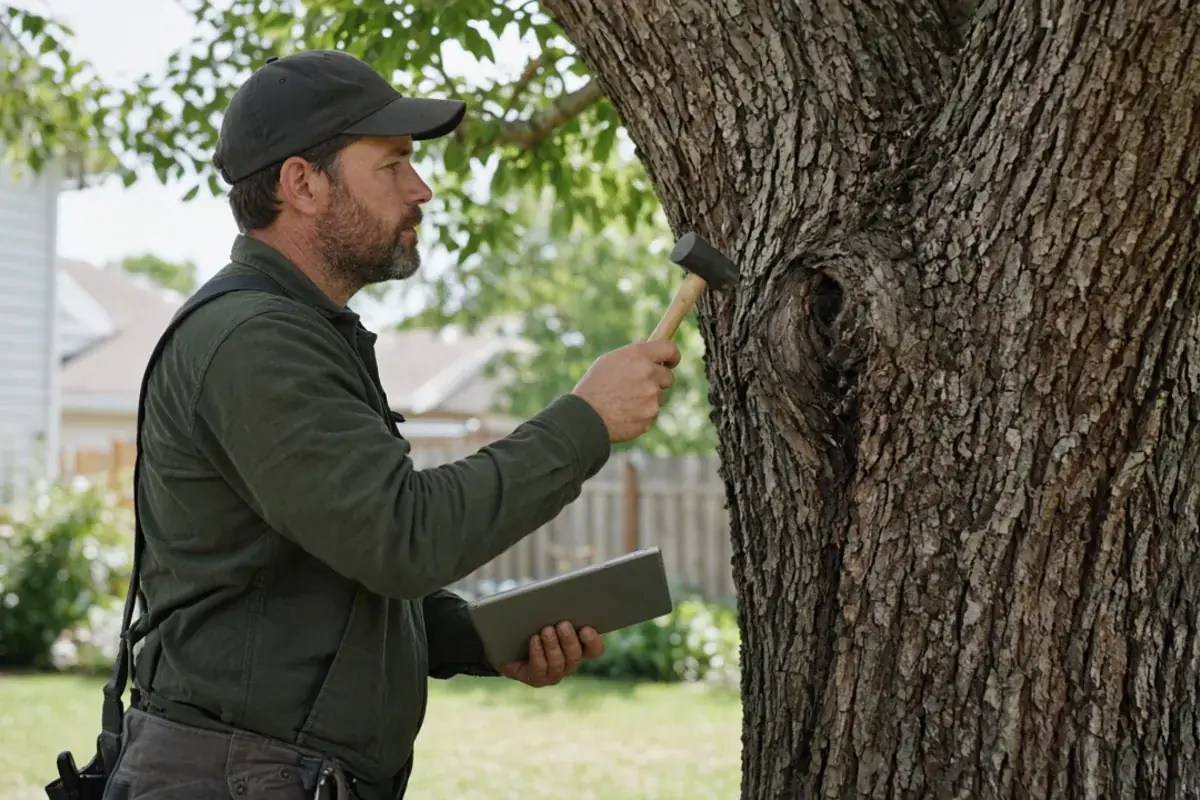
Start with the real problem
Most keep-or-remove decisions start with a specific complaint: branches over the roof, a limb that dropped on the car, roots lifting the driveway, too much shade, leaves clogging the gutters, or a tree that just looks unhealthy. The first step is to name the problem clearly, because some problems are about the tree and some are about the space around it.
A branch over the roof is a pruning problem. A cracked trunk is a structural problem. A big tree in a small front yard is a fit problem. Each points in a different direction, and only some of them lead to tree removal in Boise.
When trimming or pruning is enough
If the trunk is solid, the roots are stable and most of the canopy is healthy, the tree can usually be kept. Removing deadwood, raising low limbs over a driveway or sidewalk, clearing the roof and thinning a dense crown are everyday tree trimming jobs. Structural pruning on younger trees can correct weak forks before they become a hazard.
A tree that has lost a few branches in a storm, or has a lopsided crown, is often still a good tree. Mature shade trees take decades to replace, and in Boise's hot, dry summers that shade is worth a lot.
When removal makes more sense
Removal starts to make sense when the main structure is the problem. A dead or mostly dead tree, a deep trunk crack or split fork, extensive decay or fungus at the base, a newly leaning tree with moving roots, or a tree that keeps dropping large limbs year after year all point that way.
It can also make sense when a healthy tree is simply in the wrong place: growing into the foundation, pushing up a driveway, sitting under a power line where it will always be cut back hard, or crowding out a better tree nearby. For the specific warning signs, see signs a tree needs to be removed.
Questions that help you decide
A few honest questions usually settle it. Is the trunk sound? Are the roots stable? How much of the canopy is alive? What would it hit if a large limb failed? Will it need heavy cutting every year or two just to stay out of the way? And will it be a better tree, or a worse one, in five or ten years?
If most of the answers point to a tree that is stable, healthy and fits the site, keep it and look after it. If several point toward instability, decline or constant conflict with the house, removal is often the safer and more practical long-term choice.
Why topping is not the middle ground
One option people sometimes consider is cutting the top off a large tree to make it smaller. Topping is widely discouraged by arborists. It leaves large wounds that are prone to decay, and the tree tends to respond with fast, weakly attached sprouts that can become a bigger hazard than the original limbs.
If a tree is a little too big for its space, careful reduction pruning is sometimes possible. If it would need to be cut back drastically just to fit, removal and replanting with something better suited is usually the better answer.
Boise trees and the long view
Species plays a role in the decision. Silver maple, Siberian elm and cottonwood are fast-growing, have weaker wood and are common in older parts of the West Bench, Hyde Park and the North End. A large, aging tree of one of these species with structural problems is often harder to justify keeping than a sound honeylocust or oak with a similar canopy.
Ash trees are worth thinking about too. Emerald ash borer had not been confirmed in Idaho as of 2026, but state and university experts expect it to arrive eventually. A healthy ash can certainly be kept, but if you are already weighing removal of a struggling ash, that future risk is part of the picture.
Street trees in the planting strip are managed by the city, so the City of Boise, not the homeowner, generally decides whether those are removed. If you have concerns about one, contact Community Forestry and ask for an inspection.
If the tree comes out
Removal does not have to mean losing the shade for good. A well-chosen replacement, planted in a better spot away from the lines and the house, gives you a tree that fits. Our tree planting page covers choosing and placing a new tree, and what to expect on removal day walks through the job itself. If the tree is close to the house or lines, this guide to tight-space removals explains how that is handled.
For the cost side, see what affects tree removal cost in Boise. If you would like another set of eyes on a tree in Hyde Park or anywhere else in Boise, our arborist services cover tree assessments, and our Boise tree removal service page explains how a removal is planned when that is the right call.
Common questions
A few things people usually want to know
Should I remove a healthy tree?+
Sometimes it makes sense, for example if it is damaging the foundation, lifting paving or is far too large for the space. Otherwise a healthy, well-placed tree is usually worth keeping and maintaining.
Is it better to trim or remove a tree that hangs over my roof?+
If the tree is sound, trimming to clear the roof is usually enough. Removal makes more sense when the tree itself is structurally weak, declining or keeps dropping large limbs.
Can topping a tree make it safe?+
Generally no. Topping leaves large wounds and weakly attached regrowth, and it often makes a tree less safe over time. Reduction pruning or removal are usually better options.
Can I remove a tree in the parking strip in front of my house?+
Street trees in Boise are generally managed by the city, and work on them usually needs a permit from Community Forestry. Contact them before doing anything to the tree.
Should I plant a new tree after removal?+
Often, yes. Choosing a species that fits the space, and planting it away from the house, the lines and the old stump, gives you shade without repeating the original problem.
Keep reading
More tree removal guides
Signs a tree needs to be removed
Dead canopy, cracks, a new lean, decay and the Boise trees that tend to fail first.
Storm-damaged tree removal in Boise
What to do first after wind or snow damages a tree, from power lines to insurance.
Removing a tree near a house or power lines
How sectional removal works and how Idaho Power lines change the plan.
What to expect on tree removal day
The steps from estimate to cleanup, how to prepare and the best time of year.
How much does tree removal cost in Boise?
The factors that change the scope and price of a removal.
Tree removal permits in Boise
Street trees, Community Forestry, HOAs and other approvals to check first.
Stump grinding vs stump removal
Which stump option fits the space after the tree comes down.
Talk through the tree
Prefer to call? Start there.
If you can describe what the tree is doing, where it sits on the property and what you want to accomplish, that is enough to start the conversation. For urgent damage, mention whether the tree is leaning, split, blocking access or resting on a structure.