Tight-space removals
How do you remove a tree close to a house or power lines?
When there is no room to drop a tree, it comes down in pieces. Crews usually work from the top and the outside in, lowering limbs and trunk sections with ropes and planning around everything below. Power lines add another layer: work near them generally needs the utility involved first.
Updated October 2, 2026
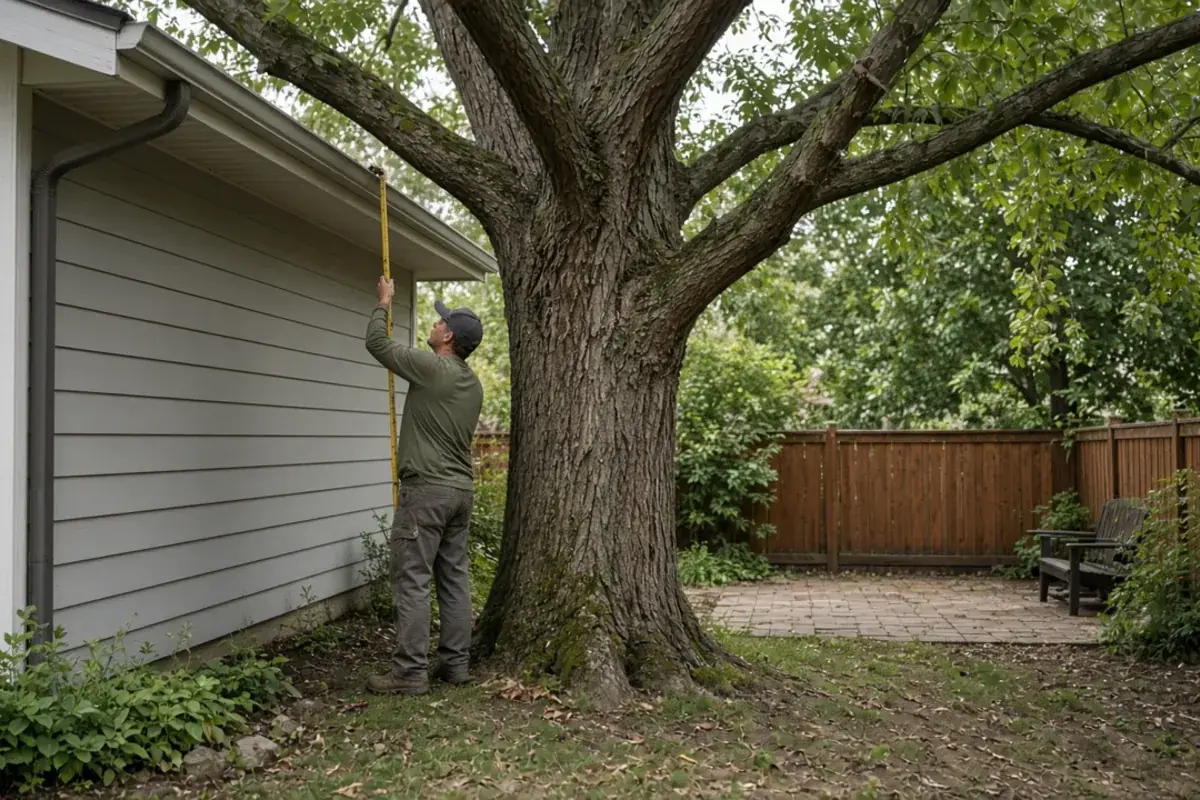
Why there is often no room to fell a tree
Felling a whole tree in one piece needs a clear landing zone at least as long as the tree is tall, plus a margin for error. On many Boise lots, especially the narrower lots in the North End, East End and Hyde Park, a mature tree is surrounded by a house, garage, fence, the neighbor's yard and overhead lines. There is simply nowhere for it to go.
That does not mean the tree cannot be removed. It means the job is planned differently, and it is one of the most common kinds of tree removal in Boise.
How sectional removal works
In a sectional removal, a climber or a lift takes the tree down from the top. Smaller branches are cut and dropped where there is room. Larger limbs and pieces of trunk that could damage something are tied off and lowered on ropes through a rigging point higher in the tree, with a ground crew controlling the descent.
As the tree gets smaller, the trunk is taken down in manageable lengths until a short stump remains. On some sites a crane may be used to lift heavy sections over a house, but that depends on access, space for the crane and the size of the tree. The point of all of this is control: every piece has a planned path to the ground.
Protecting the house, roof and yard
Before cutting starts, the crew should talk through what needs protecting. That can include the roof, gutters, windows, a deck or patio, a fence line, sprinkler heads, garden beds and the lawn along the route used to carry brush out. Plywood or mats may be laid over soft ground or delicate surfaces.
It helps to move cars, outdoor furniture, planters and anything fragile out of the area, and to tell the crew about hidden things like buried irrigation lines or a septic system. Our guide to what to expect on tree removal day has a fuller checklist.
Trees near power lines
Power lines are the biggest hazard in tree work. Idaho Power says only specially trained professionals should work near its lines, asks everyone to stay at least 10 feet away, and asks people to contact the company for an evaluation before removing trees near its lines. Most overhead lines are bare wire, and a branch can carry electricity to whoever is touching it.
For the main lines running pole to pole, Idaho Power uses line-clearance contractors to keep trees pruned back, and it may remove a tree that has become a risk to the system after talking with the owner. If you have a tree growing into those lines, contact Idaho Power first rather than hiring someone to cut near them.
The line from the pole to your house
The service drop, the wire that runs from the pole or transformer to your home, is treated differently. Idaho Power generally says pruning around service wires is not part of its routine maintenance, but if a branch is a problem it can de-energize the line during normal business hours so a tree crew can work safely. That usually means coordinating a date with the utility before the removal is scheduled.
If any part of the tree is touching or very close to a line, mention it when you ask for an estimate. It changes how, and when, the work can be done.
Neighbors, fences and shared trees
Trees on or near a property line come up often in older Boise neighborhoods. If the trunk sits on the line or the work needs access through a neighbor's yard, talk with them before the job, and it is generally wise to get agreement in writing if the tree is shared. For trees in the parking strip by the street, or in an HOA common area, approval may be needed first; our tree permit guide for Boise explains the usual situations.
If the tree is an elm, Boise's tree ordinance generally requires a permit from the City Forester before pruning or removal, even on private property, so check with Community Forestry early in the planning.
Questions to ask before the work starts
A clear plan makes a tight-space removal go smoothly. Ask how the tree will be taken down, where brush and logs will be staged, which route the crew will use through the yard, whether the stump is included, what cleanup looks like at the end, and whether any coordination with Idaho Power is needed.
Sometimes the answer is that the tree does not need to come out at all. If the main problem is branches over the roof or near the service line, tree trimming or selective limb cutting might be enough; our guide on whether to remove or save a tree can help you decide. When removal is the right call, our Boise tree removal service page covers how we plan it, and our cost guide explains why tight access changes the scope. We work throughout Boise, including the North End and the East End.
Common questions
A few things people usually want to know
Can a tree right next to a house be removed safely?+
In most cases, yes. It is usually taken down in sections from the top, with heavier pieces lowered on ropes so nothing drops onto the house.
Will Idaho Power remove a tree near power lines?+
Idaho Power maintains clearance around its main lines and may remove a tree that has become a risk to the system after discussing it with the owner. Contact the company first for an evaluation.
Who handles branches near the line to my house?+
Idaho Power generally does not prune around service wires as routine maintenance, but it can de-energize the line during business hours so a qualified crew can do the work safely.
Do I need my neighbor’s permission to remove a tree on the property line?+
For a shared tree it is generally best to get agreement first, ideally in writing. The rules can vary, so check if you are unsure.
What should I move before a tree near my house is removed?+
Move cars, patio furniture, planters, grills and anything fragile out of the work area, and let the crew know about sprinklers, buried lines or a septic system.
Keep reading
More tree removal guides
Signs a tree needs to be removed
Dead canopy, cracks, a new lean, decay and the Boise trees that tend to fail first.
Storm-damaged tree removal in Boise
What to do first after wind or snow damages a tree, from power lines to insurance.
What to expect on tree removal day
The steps from estimate to cleanup, how to prepare and the best time of year.
Remove or save a tree?
How to decide between trimming, pruning and removal for a problem tree.
How much does tree removal cost in Boise?
The factors that change the scope and price of a removal.
Tree removal permits in Boise
Street trees, Community Forestry, HOAs and other approvals to check first.
Stump grinding vs stump removal
Which stump option fits the space after the tree comes down.
Talk through the tree
Prefer to call? Start there.
If you can describe what the tree is doing, where it sits on the property and what you want to accomplish, that is enough to start the conversation. For urgent damage, mention whether the tree is leaning, split, blocking access or resting on a structure.